
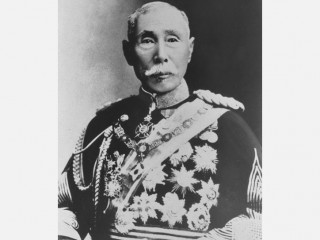
Aritomo Yamagata biography
Date of birth : 1838-04-22
Date of death : 1922-02-22
Birthplace : Hagi, Japan
Nationality : Japanese
Category : Historian personalities
Last modified : 2010-12-15
Credited as : General, ,
Aritomo Yamagata was a Japanese general and a member of the oligarchy which dominated Meiji Japan. He was instrumental in building a modern army, strengthening the power of the civil and military bureaucracy, and checking the development of popular influences on the government.
Aritomo Yamagata was born the son of a low-ranking samurai family on April 22, 1838, in Hagi, the castle town of Choshu domain. Like Hirobumi Ito Yamagata studied at the private academy of Shoin Yoshida, who advocated revolt against unworthy rulers and severely criticized the shogunate's weak response to the Western nations. Not surprisingly, Yamagata became an active participant in the imperial loyalist movement in Choshu. As an officer of the Kiheitai, a militia force made up of both peasants and samurai, he fought under the leadership of Shinsaku Takasagi in engagements with the Westerners at shimonoseki, in the Choshu civil war, and in the wars of the restoration.
During the 1870s Yamagata became the main force behind the organization of a national army. He was the chief architect of the military conscription law of 1873, which created an army recruited from the peasantry and other commoners as well as from the former samurai class. He also introduced in 1879 the German model of a general-staff system of military administration, which made the army independent of civilian control. He held high-ranking positions in the army until his death, exercising considerable influence on military planning and policy, and his proteges dominated the military high command down to the early 1920s.
Although Yamagata was radical in his military innovations, he was a thoroughgoing conservative in civilian politics. As minister of home affairs from 1883 to 1888, he built up a strong centrally controlled police force, drafted laws suppressing political opposition, and reorganized the local government system in order to strengthen the power of local officials to maintain local order. He wished to keep political power in the hands of a responsible, dedicated bureaucracy, free of self-interest and backed by the more stable propertied elements in the countryside.
Yamagata grudgingly supported the constitutional system devised by Hirobumi Ito, serving twice as premier (1889-1891, 1898-1900). Yamagata remained a firm believer in "transcendental government", free from control or interference by the popularly elected house of the Diet. As genro, or senior statesman, he bent every effort to keep political party leaders from organizing cabinets and maneuvered to put his own followers in the premiership. Only in 1918 did he finally consent to the idea of party rule.
Yamagata was an advocate of a strong foreign policy, based on the need to extend Japan's defense perimeter to Korea and the Asian mainland. He supported enthusiastically the decision to fight China in 1894, and subsequently he urged an anti-Russian policy, which led to war and victory in 1905. He continually sought to buttress Japan's military position and political influence on the Asian mainland.
At his death on Feb. 22, 1922, Yamagata had long been one of the most powerful figures on the political scene. But because of his opposition to popular government and his cold and aloof personality, he was also one of the least popular.
Roger F. Hackett, Yamagata Aritomo in the Rise of Modern Japan, 1838-1922 (1971), is an able and scholarly biography based on Japanese sources. Both Josef Washington Hall, Eminent Asians: Six Great Personalities of the New East (1930), and Marius B. Jansen, ed., Changing Japanese Attitudes toward Modernization (1965), devote a chapter to Yamagata and his work. An interesting contemporary study is Rikitaro Fujisawa, The Recent Aims and Political Development of Japan (1923). For general background see Hugh Borton, Japan's Modern Century, from Perry to 1970 (1955; rev. ed. 1970); George M. Beckmann, The Modernization of China and Japan (1962); Joseph Pittau, Political Thought in Early Meiji Japan, 1868-1889 (1967); and Robert E. Ward, ed., Political Development in Modern Japan (1968).