
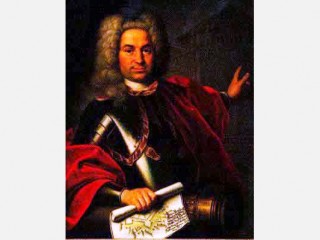
Balthasar Neumann biography
Date of birth : 1687-01-27
Date of death : 1753-08-19
Birthplace : Cheb, Bohemia
Nationality : German
Category : Arhitecture and Engineering
Last modified : 2011-01-04
Credited as : Architect and engineer, works: Residenz in Wurzburg , and the church of Vierzehnheiligen
The German architect Balthasar Neumann created some of the finest baroque buildings of the 18th century for the Schonborn family in central Germany, notably the Residenz in Wurzburg and the church of Vierzehnheiligen.
In the great flowering of the arts which took place in central Europe during the early decades of the 18th century, it was largely in the field of architecture that the most famous achievements were made. The greatest architect of the time, it is acknowledged, was Johann Bernhard Fischer von Erlach of Vienna. His spiritual heir was Balthasar Neumann, who, working for the powerful Schonborn family, key figures at the imperial court and rulers of several important principalities within the Holy Roman Empire and passionate builders all, was provided with almost limitless possibilities to display his talents.
Neumann was born in January 1687 at Eger (Erlau) in Bohemia, the son of a clothier. He was trained as a cannon and bell founder but apparently showed such promise that he was sent to Wurzburg to study civil and military engineering, as well as to continue his work in the foundries. In 1714 he enlisted in the palace guards at Wurzburg as a lieutenant of artillery; he served in the imperial forces in the Belgrade campaign of 1717 as a military engineer.
After 3 years of travel Neumann returned to Wurzburg, where, with the architect Johann Dientzenhofer, he shared responsibility for planning the future episcopal palace, which the Prince-Bishop Philip Franz von Schonborn had decided to build in place of his residence in the fortress of Marienburg overlooking the city. This enterprise occupied Neumann for most of his life and was the crowning achievement of his career.
Although Neumann's control over the planning of the episcopal palace was anything but absolute at the beginning, for the prince-bishop sought advice about it every-where—from his relatives, from other German architects like Maximilian von Welsch and Johann Lucas von Hildebrandt, and even from the French architects Robert de Cotte and Gabriel Germain Boffrand—Neumann gradually won the confidence of his patron and served as the stabilizing influence and coordinator of all their suggestions and alterations, adding his own ideas as well to the general scheme. It is chiefly Hildebrandt's influence, particularly in the treatment of surfaces, that predominates over all the others. The result of this collaboration was a huge building complex, with a cour d'honneursurrounded on three sides by blocks with inner courts, the central block accentuated by the large octagonal dome over the main hall, and the exterior facades enlivened by pavilionlike projections. The palace chapel, designed by Neumann and decorated by Hildebrandt (begun in 1730), has a basic plan of intersecting ovals, and its almost bewilderingly rich interior decoration is in marked contrast to the relatively plain exterior of the building.
In the great stairway, which Neumann began in 1737, he revealed his special talent, the manipulation of dynamic space. A single flight of stairs leads from the ground floor to the landing, where two flights then lead up and back to the main floor. In this huge space, for the ceiling is unsupported by arcades or columns, the visitor only gradually becomes aware of the size of the stairway hall and of the vastness and complexity of the fresco decoration executed by Giovanni Battista Tiepolo (1752-1753). In his representation of the four continents he created his finest fresco. On the cornice before the personification of Europe, he portrayed Neumann in his military uniform, seated on a cannon, one of the more appealing portraits of the period. The stairway lacks the elaborate balustrade which Hildebrandt certainly planned for it, and the rich effects he had intended have been diminished. This is not the case in the Marble Hall, which serves as the climax for the whole stairway, where the huge enclosed oval space is enriched with splendid stucco ornament and with frescoes by Tiepolo (1750-1752).
At Schloss Bruchsal (destroyed), where Neumann was called to work in 1728 after much of the palace had been done, he was able to continue his work on stairways. Here he constructed (1731-1732) an oval landing joining the staterooms, with the stairways encircling it as they ascend, presenting a rather enclosed feeling until one arrives at the spacious and elaborate landing on the main floor. He was able to resolve, again, the problem of the stairway (1740) at Schloss Brühl by lightening the supporting walls of the upper flights with arches, thus giving a spacious effect to the whole lower level of the stairwell. The stairs seem to float in the air as they rise upward to the richly decorated upper level, topped with an oval dome pierced with windows.
During the 1740s Neumann began his two greatest churches: the pilgrimage church of Vierzehnheiligen near Bamberg, and the abbey church at Neresheim in Swabia. The church at Vierzehnheiligen (1743-1772) was to have, as its central element, an altar built over the spot where the 14 saints known as the Helpers in Need had appeared in a miraculous vision. At first it was thought that the church should be built on a central plan, but Neumann's design for a longitudinal-plan church with the altar under the dome over the crossing was accepted. The builder entrusted with the construction began the chancel incorrectly, and Neumann had to step in and alter his plan, so that the altar was now in what would have been the nave. He skillfully resolved this unfortunate situation by breaking the nave up into ovals; in the center of the largest oval was the altar, thus giving the impression that it is, indeed, in the center of the whole edifice.
This concern with blending a central-plan church with a longitudinal nave, so fortuitously worked out at Vierzehnheiligen, found its fullest expression at Neresheim, Neumann's last great church (1747-1792). Here the longitudinal oval of the crossing grows out of the ovals of the transepts and the two ovals which make up the nave and the two of the deep chancel, yet the whole is broken up in such a way that one sees only a vast and intricate articulated space over which the dome seems to float. Although altered somewhat after Neumann's death, it still is the purest expression of his architectural ideas.
Throughout his life Neumann remained an officer in the bishop's military and continued to concern himself with problems of military engineering. He also developed a freshwater supply for the city of Wurzburg (1730), built a glass factory and a mirror factory (1733), and taught military and civil engineering at the University of Wurzburg.
Neumann was fairly prosperous, the owner of vineyards and a fine country house. Although under the less splendid successors of the Schonborn bishops he was not always able to build as he would have wished, he continued to concern himself until his death with plans for great palaces, complete with vast and complex stairways, such as his designs for the Hofburg in Vienna (1747) and the palaces at Stuttgart (1747, 1749, 1750) and Karlsruhe (1749), none of which were executed. He died, a colonel, in Wurzburg on July 18, 1753.
The only literature on Neumann in English is contained in Nicolas Powell, From Baroque to Rococo (1959); John Bourke, Baroque Churches of Central Europe (1962); Eberhard Hempel, Baroque Art and Architecture in Central Europe (1965); and Henry-Russell Hitchcock, Rococo Architecture in Southern Germany (1968).