
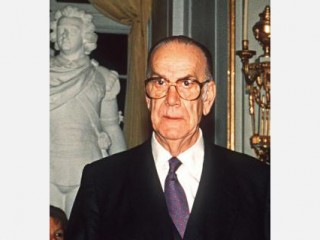
Camilo Jose Cela biography
Date of birth : 1916-05-11
Date of death : 2002-01-17
Birthplace : Iria, Galicia, Spain
Nationality : Spanish
Category : Famous Figures
Last modified : 2011-01-26
Credited as : Author, prose stylist,
The Spanish author Camilo Jose Cela y Trulock was a prose stylist of extraordinary ability. He is generally considered the major Spanish literary figure of the post-Civil War generation.
Camilo Jose Cela was born in Iria Flavia, Galicia, where his father's ancestors—some renowned, some of peasant stock—had lived for generations. His mother was of English ancestry. When he was 9, his family moved to Madrid, where Cela later attended a number of secondary schools run by religious orders, finally graduating with an undistinguished record. At the University of Madrid he studied, in turn, medicine, liberal arts, and law but abandoned all three fields without earning a degree.
In 1942 Cela's short novel The Family of Pascual Duarte exploded upon the literary scene in Spain. After the upheaval of the Civil War the Spanish novel had almost ceased to exist. Baroja, Azorin, and Perez de Ayala had little new to say, and Unamuno and Valle Inclán had both died in 1936. The Family of Pascual Duarte, somewhat like Albert Camus's The Stranger, which appeared in the same year, presents an alienated character whom fate seems to drive to unbridled violence. The violent actions of the protagonist, which cannot be fully explained sociologically or psychologically, are generally symbolic of the hopeless chaos of post-Civil War Spain.
This novel introduced the Spanish literary manner known as tremendismo, a neobaroque and neopicaresque style, which concentrates on the violent and grotesque. Tremendismo is marked by extravagant and strident diction pointed toward the ugly, by sallies of grimly ironic humor, and by the presentation of irrational and alienated characters.
After Rest Home (1943), which is based on Cela's experience in a tuberculosis sanitarium, and Las nuevas andanzas y desventuras de Lazarillo de Tormes (1944; The New Fortunes and Misfortunes of Lazarillo de Tormes), Cela changed directions and published The Hive (1950), which many regard as his greatest novel. In the beehive of metropolitan Madrid more than 200 characters, all of them fearful and lonely, pursue the necessities of food and sex. The novel emphasizes the grim impersonality of human relations and the pettiness of man's existence.
Since Cela preferred not to develop sustained characters in his novels, he turned to another type of literature, the travel book. His first, Viaje a la Alcarria (1948; Journey in the Alcarria), became a minor classic, and he published several others. In these books the author as wayfarer trods the roads of ancient Spanish regions such as the Alcarria, attempting to discover the heart of the Spanish land and people.
Cela also wrote short fiction with marked success. His Apuntes carpetovetónicos (1955) contains penetrating snapshots of provincial life. Of this type, his El gallego y su cuadrilla is a minor masterpiece. Cela's talents also lent themselves to novelettes, among which his best are probably Timoteo el incomprendido and Cafe de artistas, included in the volume El molino de viento (1956; The Windmill).
After 1956 Cela lived with his wife in Palma de Mallorca, where he edited the literary journal Papeles de son Armadans and continued to write a variety of literary works, none of them, however, novels. Cela's outstanding achievement was the cultivation of a style and manner which expressed not only his original and complex personality but also the preoccupations of modern man. After the Spanish dictator Franco died, Cela served as a delegate to the new constitutional convention. He also became somewhat known for a high lifestyle, driving at different times a Rolls Royce, a Bentley, and a Jaguar. In an interview around the time of his 80th birthday, he derided the notion of inspiration as a necessary ingredient for writers. "Picasso once said, I don't know if inspiration exists, but when it comes, it usually finds me working.' What a person has to do is sit himself down before a stack of blank papers, which is in itself terrifying. There is nothing as frightening as a stack of blank pieces of paper and the thought that I have to fill them from top to bottom, placing letters one after the other."
There are two studies of Cela's work in English: Robert Kirsner, The Novels and Travels of Camilo Jose Cela (1964), and David W. Foster, Forms of the Novel in the Work of Camilo Jose Cela (1967).