
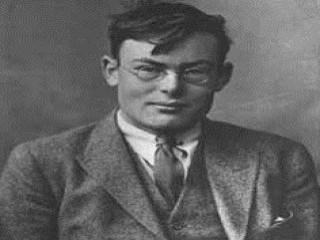
Frank Ramsey biography
Date of birth : 1903-02-22
Date of death : 1930-01-19
Birthplace : Cambridge, England
Nationality : English
Category : Science and Technology
Last modified : 2011-04-27
Credited as : Mathematician, and philosopher, Magdalen College
The English mathematician and philosopher Frank Plumpton Ramsey was recognized as an authority in mathematical logic.
Frank Ramsey was born on Feb. 22, 1903. His father, Arthur Ramsey, was president of Magdalen College. Ramsey's excellent work at Winchester College won him a scholarship to Trinity College, Cambridge. He was Allen University scholar in 1924 and in the same year was elected a fellow of King's College and appointed lecturer in mathematics at the university.
Ramsey's precocious talents were legendary at Cambridge. From about his sixteenth year he was consulted by theorists in mathematics and other subjects in which mathematics is largely used. The economist John Maynard Keynes reported, "Economists living in Cambridge have been accustomed from his undergraduate days to try their theories on the keen edge of his critical and logical faculties." And indeed in his brief life Ramsey made two important contributions to economic theory: "A Mathematical Theory of Saving" and "A Contribution to the Theory of Taxation." Of the first of these, Keynes wrote that it is "one of the most remarkable contributions to mathematical economics ever made."
But Ramsey's contributions to the subject that taxed the best abstract theorists of the day, the foundations of mathematics, were even more impressive. At the age of 22 he presented a brilliant defense of the mathematical theories of Bertrand Russell and Alfred North Whitehead against Continental critics. Using the Tractatus of Ludwig Wittgenstein, which he was among the first to appreciate, Ramsay succeeded in removing some of the most serious objections to the logicist theory. He showed how the ad hoc axiom of reducibility, one of the most vulnerable parts of Principia Mathematica, by Russell and Whitehead, could be eliminated, and he offered ways of improving the concept of identity used in that work.
Ramsey also made important contributions to the philosophy of science. In an effort to clarify the role played by theory in science, he introduced the important idea that scientific laws could be regarded as "inference licenses," a theme that was developed further by Gilbert Ryle and S. E. Toulmin. Taking up the work of the American philosopher C. S. Peirce on inductive logic, Ramsey sought to provide sharper criteria for the acceptability of beliefs.
On the question of whether there are important truths inaccessible to language, Ramsey went still further than his friend and colleague Wittgenstein. He gave an answer that was repeated by a generation of Cambridge students: "What we can't say, we can't say and we can't whistle it either."
Ramsey was widely regarded as having no equal in his generation for sheer power and quality of mind and in the originality and promise of his work. A man of large, "Johnsonian" build, he was straightforward and blunt in conversation and modest about his exceptional gifts. He died after an operation at the age of 26 on Jan. 19, 1930, survived by his wife and two daughters.