
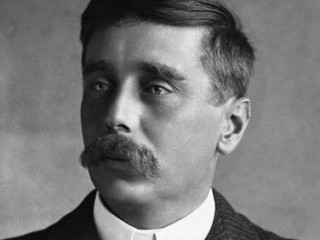
H. G. Wells biography
Date of birth : 1866-09-21
Date of death : 1946-08-13
Birthplace : Bromley, Kent, England
Nationality : English
Category : Famous Figures
Last modified : 2011-06-20
Credited as : Novelist, science fiction author, The Time Machine, The Invisible Man
The English author Herbert George Wells began his career as a novelist with a popular sequence of science fiction that remains the most familiar part of his work. He later wrote realistic novels and novels of ideas.
On Sept. 21, 1866, H. G. Wells was born in Bromley, Kent. His origins were lower middle class, his father being a semiprofessional cricket player and his mother an intermittent housekeeper. At the age of 7 Wells entered Morley's School in Bromley, leaving at the age of 14, when he became apprenticed to a draper. He rebelled against this fate in 1883. After a year of teaching at a private school, he won a scholarship to the Normal School of Science at South Kensington in 1884, where he studied under the biologist T. H. Huxley. Wells left Kensington without a degree in 1887, returning to teaching in private schools for three years. He received a degree in science from the University of London in 1890.
Wells began teaching at a correspondence college in London in 1891 after his marriage to his cousin Isabel. The marriage was both difficult and brief. In the same year he published his article "The Rediscovery of the Unique" in the Fortnightly Review. After three years of writing on educational topics, he published his first novel, The Time Machine. Divorcing his first wife, Wells remarried in 1895 and abandoned teaching. A series of scientific fantasies followed The Time Machine: The Island of Dr. Moreau (1896), The Invisible Man (1897), The War of the Worlds (1898), When the Sleeper Awakes (1898), The First Men in the Moon (1901), and The War in the Air (1908). Wells's involvement with socialism and radicalism had begun in 1884 and continued for the remainder of his life.
Love and Mr. Lewisham (1900), Wells's first nonscience fiction novel, concerned the relationship of men and women and introduced sex as an integral part of that relationship. His semiautobiographical novels continued with Kipps (1905), Tono-Bungay (1909), and The History of Mr. Polly (1910). These novels are considered his greatest achievement.
As his novels indicate, Wells was hostile to the Victorian social and moral orders. His criticism became explicit as his involvement with radical causes grew. Wells as prophet wrote Anticipations (1901), Mankind in the Making (1903), and A Modern Utopia (1905). He joined the Fabian Society, a socialist group that included George Bernard Shaw and Sydney Webb, in 1903; after an unsuccessful attempt four years later to turn Fabianism to mass propaganda and political action, Wells resigned. The New Machiavelli (1911), a novel, was a response to his experience in the society. After The New Machiavelli he began producing dialogue novels that expressed his current preoccupations. His Boon (1915) parodied the late style of Henry James.
Wells became during World War I an expert publicist, particularly in Mr. Britling Sees It Through. Initially believing that the war would end all war, he wrote that "my awakening to the realities of the pseudo-settlement of 1919 was fairly rapid." His solution was what he identified as world education. The intention of The Outline of History (1920) was to "show plainly to the general intelligence, how inevitable, if civilization was to continue, was the growth of political, social, and economic organizations into world federation." After the Outline's appearance, Wells led an increasingly public life, expressing his opinions through syndicated articles. The Open Conspiracy: Blue Prints for a World Revolution (1928) urged the case for an integrated global civilization.
Experiment in Autobiography (1934) was "an enormous reel of self-justification." Wells continued to average two titles a year. Apropos of Delores (1938) was a hilarious tribute to a former mistress. Mind at the End of Its Tether (1945), his last book, was a vision of the future as nightmare. He died on Aug. 13, 1946, in London.