
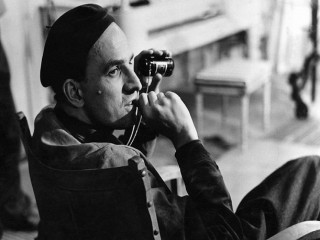
Ingmar Bergman biography
Date of birth : 1918-07-14
Date of death : 2007-07-30
Birthplace : Uppsala, Sweden
Nationality : Swedish
Category : Arhitecture and Engineering
Last modified : 2011-04-15
Credited as : Film and stage director, Goethe Prize, Crisis
The works of Swedish film and stage director Ingmar Bergman are marked by intellectuality, metaphysical speculation, and symbolic and allegorical content.
Ingmar Bergman was born on July 14, 1918, in Uppsala, Sweden, the son of a Lutheran minister. He attended the University of Stockholm, where he became an active member of the student theatrical group. In 1942, after a brilliant production of Macbeth, the aspiring director was appointed to the Swedish Royal Opera. In the years following he divided his talents equally between stage and film efforts.
In 1945 Bergman directed his first film, Crisis, the story of an unhappy love affair which ends in suicide. Several films followed in close succession, but in 1956 with The Seventh Seal Bergman reached the pinnacle of critical and popular acclaim. The Seventh Seal is a medieval morality play about a moribund knight who, seeking to placate his religious doubts and unravel the mystery of the universe, challenges Death to a game of chess. Even Bergman's critics concede that this film has visual audacity and great dramatic power.
A year later Bergman directed Wild Strawberries, a brilliantly integrated work conceived in cinematic rather than literary or dramatic terms. A poignant study of the abyss between youth and old age, the effort projects a sad lyricism and warm Chekhovian glow. With his next film, The Magician (1959), Bergman returned to his earlier use of symbolism. It is the story of a group of wandering magicians and their encounters with otherworldly spirits. The Virgin Spring, a second venture into the medieval milieu, followed in 1960, as well as several lesser works.
In 1961 Bergman embarked upon his ambitious trilogy, beginning with Through a Glass Darkly, an intense, almost hysterical, study of familial violence. The second contribution, Winter Light (1962), presents the emptiness which follows loss of faith; while the final portion, The Silence (1963), explores with surreal imagery the dilemma of verbal inadequacy and the attendant terror of noncommunication. The trilogy is concerned with the problem of God's absence rather than His illusive presence and with the anguish arising from personal isolation rather than the enigma of human existence itself, and it presents Bergman's increasingly complex world view.
This sophistication is also evident in the coldly poetic lucidity and psychological ambiguity of Persona (1966). This masterpiece tells of a bizarre relationship between a young actress who has lapsed into catatonic silence and the loquacious nurse who cares for her. The film provides a fascinating insight into the dark recesses of human identity and the agonies of self-confrontation. The Hour of the Wolf (1968), about an artist who is haunted by spectres, marks what some feel is a regrettable return to Bergman's earlier use of mysticism. Shame (1968), an analysis of the degeneration induced by war, is as stylistically refined as Persona but lacks that film's oblique and richly textured inner resonance.
Due to tax problems Bergman spent much of the 1970s abroad and produced work for television in Norway and Germany as well as Sweden. His major theatrical films of this period include Cries and Whispers (1971) and Autumn Sonata (1978). Highly regarded among the television work are Scenes from a Marriage (1973) and The Magic Flute of the same year.
In 1982 Bergman released one of his most autobiographical films, the richly detailed Fanny and Alexander. Announced as his final film, it brings together many different themes from his previous works and is a powerful summary of his life and career. It is one of his most accessible films and quite possibly his best.
Since Fanny and Alexander Bergman has published an autobiography, The Magic Lantern (1988); and a novel, Best Intentions (1989); as well as continuing to write and direct for Swedish television and theater. Best Intentions was produced, from Bergman's script, for Swedish television in 1991.
Bergman's reputation has diminished, somewhat, in recent years, but he is still regarded as one of the great directors, and his films remain among the most widely recognized in the world. Many well-known American directors, such as Woody Allen, have paid homage to Bergman in their own films.