
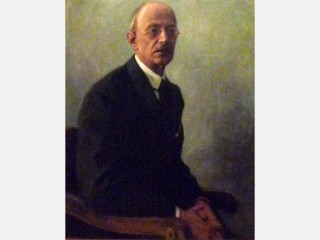
Kálmán Kandó biography
Date of birth : 1869-07-10
Date of death : 1931-01-13
Birthplace : Budapest, Hungary
Nationality : Hungarian
Category : Arhitecture and Engineering
Last modified : 2010-05-31
Credited as : Engineer in railways, Electric locomotive with phase converter, Technical University of Budapest
0 votes so far
He is father of modern electric trains.
Kálmán Kandó was born on July 10, 1869, in Budapest, Hungary. He started his secondary studies in the Evangelical Grammar School at Deak Square, Budapest, and took his baccalaureate at the former Main Teacher Training Grammar School (today’s Trefort Street Grammar School) founded by famous educator and educational politician Mor Karman (1843-1915). Kalman Kando obtained his diploma as a mechanical engineer at the Technical University of Budapest.
His engineer’s career started in France where he worked as a junior engineer designing and developing Tesla’s induction motor. Later on Andras Mechwart (the Ganz factory’s managing director at that time) called him to return home in 1894 and invited him to the Electrical Engineering Department – established in 1878 – of the already internationally reputed Ganz Works.
Shortly afterwards, Kandó designed the three-phase motor and generator series. His interests soon guided him towards railway electrification, and he developed electrified railways operated by high-voltage alternating current. His most marvelous invention is the phase-changing electric locomotive, which was named Kando-locomotive after him.
This revolutionary invention transforms standard public utility (single-phase) current into three-phase alternating current in the locomotive and therefore makes it capable of hauling. The first electrified railway line in Europe, the Valtellina line in Italy, was completed on the basis of his designs. This line was the first in the world to be operated by high-voltage alternating current.
One of the sensations of the summer season in 1898 was a small electric train carrying the guests of a French lakeside hotel at Evian Les Bains to and from the close-by medicinal spring. The “S”-shaped track was merely 300 metres long, the train ran only at a speed of 10 km/hour, yet, its novel construction aroused great interest. The motor wagon was supplied by the Budapest-based Ganz Factory.
It was designed by a 29-year-old engineer, Kalman Kando, who had been already working on a project of much greater size, the electrification of the Northern-Italian Valtellina Railway. A total of 30 percent of this 106 km long line ran through tunnels and half of it ran along curves.
For the first time in railway history, Kando applied high-voltage, 15-period, 3-phase system for electric traction, a daring solution at that time. Kandoas brilliance in both mechanical and electric engineering allowed him to work out all the details of his concept alone. The Valtellina line was opened on September 4, 1902 and its success earned great international recognition for Kando. Kandoas invention of the phase-changing electric locomotive undoubtedly opened a new epoch in the history of railway development.
Following these successful achievements, Kando lived in Italy from 1907 to 1915, and returned home at the outbreak of war, but he was exempted from military service. He became the managing director of the Ganz and Co. Wagon and Machinery Works. On Kando’s initiative and under his leadership the factory began work on three-phase hauling for railways.
At the end of World War I, Kando pointed out that railway electrification is “only one chapter in the great problems of energy management and can be tackled successfully only within this context”. His research focused on creating large energy systems, in which electric current generated for lighting and industrial use, were also used for electric haulage.
He worked out a revolutionary system of phase-changing haulage, whereby locomotives were powered by the standard, 50-period, single-phase alternating current used in the national energy supply system. By integrating the electric power needs of the railways, the industry and the public, Kando managed to find the ideal solution for energy rationalisation for any country. He worked on the phase-converter system to the end of his life. His work is recognized abroad, as well, mainly for the 50-phase, electric railway supplied from the national electrical system.
The world’s first electric locomotive with phase converter
In 1923, the first electric locomotive with phase converter was constructed on the basis of Kando’s designs, and serial production began soon after. The section of the Hungarian State Railways between Budapest – Hegyeshalom – Vienna (1929) was built based on Kand&o’s invention. The Ganz Works achieved significant results in the development and production of the electric engine in the course of the last fifty years.
Kalman Kando was awarded an honours degree in mechanical engineering at the Joseph Technical University of Budapest in 1892.
During his lifetime Kando held nearly 70 patents. He died on January 13, 1931, in Budapest.