
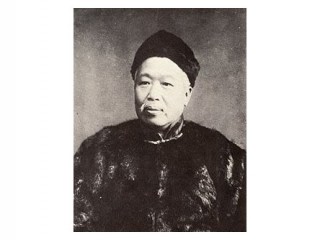
K'ang Yu-wei biography
Date of birth : 1858-04-19
Date of death : 1927-03-31
Birthplace : Nanhai District, Guangdong, Qing Empire
Nationality : Chinese
Category : Famous Figures
Last modified : 2011-08-25
Credited as : Scholar, calligrapher ,
K'ang Yu-wei was one of the most prominent scholars of modern China, particularly famous for his radical reinterpretations of Confucianism and for his role as the Emperor's adviser during the abortive Hundred Days Reform movement of 1898.
In the late 19th century the helplessness of China in the face of the imperialist powers was becoming increasingly difficult to ignore. Chinese literati, who in midcentury had been supremely confident of the superiority of China's traditional ways, were becoming aware in the 1880s and 1890s that their nation's political institutions and economic system must be reformed if China were to avoid becoming a colony of the Europeans.
K'ang Yu-wei was born near Canton to a scholarly and locally prominent family on March 19, 1858. Like his father and grandfather, K'ang prepared for a bureaucratic career by studying the Confucian classics in preparation for the civil service examinations. He passed the first series of examinations, but in 1876 he failed the provincial examinations. K'ang thereupon began 3 years of study under the scholar Chu Tz'uch'i. It was under Chu's tutelage that K'ang adopted an eclectic approach to the various schools of interpretation of the Confucian classics. In particular, K'ang learned to search for the ultimate truths in the words of Confucius himself, rather than in latter-day commentaries.
The period of study with Chu Tz'u-ch'i ended in late 1878, when K'ang experienced an emotional crisis. He suddenly sensed that his preoccupation with pedantic Confucian learning was suffocating his intellectual talents. He shut himself into his room and sat in solitary meditation, causing his friends to think he had gone mad. This retreat from the world ended after he suddenly received mystical enlightenment. "I perceived suddenly," he wrote later, "that I was in an all-pervading unity with Heaven, Earth, and all things. I beheld myself as a sage and laughed for joy. But thinking of the sufferings of mankind I suddenly wept in sorrow."
Now believing himself a sage destined "to set in order all under Heaven," K'ang broadened his studies to include governmental organization and political geography; he also read extensively in Mahayana Buddhism. Curious about the Western nations, he visited Hong Kong in 1879 and in 1882 toured the foreign concessions in Shanghai. Greatly impressed by the cleanliness and orderliness in these cities, he realized that the Europeans were different from the "barbarians" of Chinese antiquity. And in 1882 he began seriously studying the West through the relatively meager literature on the subject then available in Chinese.
Between 1888 and 1890 K'ang acquired a new insight into the Confucian classics that was to provide the basis for his mature philosophy. He became convinced that the orthodox and officially sanctioned version of the classics had in large part been forged during the ascendancy of the usurper Wang Mang (ruled A.D. 8-23). Instead of these "Old Text" versions, K'ang favored the "New Text" versions—which had once been the basis of the Confucian orthodoxy during the Former Han Dynasty—probably because they could be more easily put to the service of a political reform movement.
Making selective use of the New Text interpretations, K'ang now wrote two of his most important books. In The Forged Classics of the Wang Mang Period (1891), he mobilized evidence to demonstrate that the orthodox texts of the classics were not authentic. And in Confucius as a Reformer (1897), he argued that Confucius was the real author of the classics—Confucius's statement that he was not the author but merely the transmitter of the teachings of the ancient sages had been Confucius's stratagem to win acceptance for his own teachings. K'ang therefore insisted that Confucius had been a reformer who believed that institutions had to be adapted to altered circumstances. K'ang's conclusion was that Confucius, had he been alive in the 1890s, would also have advocated the reform of the existing political and economic order.
K'ang Yu-wei opened a school in Canton in 1891, and many of the students, like Liang Ch'i-ch'ao, were in later years his most avid partisans. The course of study at the school contained K'ang's own interpretations of Confucianism but included also the study of the West, mathematics, music, and even military drill.
In 1893 K'ang passed the second, or provincial, civil service examinations, and in 1895 he succeeded in the highest, or metropolitan, examinations in Peking. He was thereupon appointed a secretary second-class in the Board of Works and might have pursued a normal bureaucratic career had he not in the same year, at the age of 37, burst upon the national political stage.
In April 1895 the Treaty of Shimonoseki, ending the Sino-Japanese War, was signed. The terms of the treaty were humiliating and damaging to China, and K'ang Yu-wei, together with Liang Ch'i-ch'ao, drafted a petition urging the court to disavow the treaty. They acquired the signatures of nearly 1,300 scholars. The petition had no effect on the outcome of the peace settlement; but K'ang, undaunted, quickly sent two memorials to the Emperor proposing extensive governmental, educational, and economic reforms. When these memorials similarly failed of acceptance by the court, K'ang turned his energies to organizational and propaganda work, hoping thereby to broaden interest in reform among the literati.
The most notable of several reform societies with which K'ang associated himself between 1895 and 1898 was the Ch'iang-hsueh hui (Society for the Study of National Strengthening). This was organized in August 1895 and won the support of numerous eminent officials, such as Chang Chih-tung and Yuan Shih-k'ai. The successes of this reform society frightened powerful conservative officials, and the Ch'iang-hsueh hui was banned in early 1896.
During 1897 and early 1898 the foreign powers were staking out "spheres of influence" in China, and the partitioning of the country by the imperialists seemed imminent. This renewed threat inspired K'ang Yu-wei to new reform endeavors. He formed several new societies, most prominent of which was the Pao-kuo hui (Society for the Preservation of the Nation). This organization was founded in April 1898 with the avowed goal of saving "the nation, the race, and the Confucian teaching." He also submitted a succession of reform memorials to Emperor Kuang-hsu. The Emperor had now also become convinced of the need for reform, and in January 1898 he commanded K'ang to elaborate his reform proposals. K'ang also wrote two short books for the Emperor, one on Peter the Great of Russia and one on the Japanese Meiji restoration, and these reportedly strengthened the Emperor's determination to modernize the nation.
On June 12, 1898, Kuang-hsu issued a momentous edict proclaiming a new national policy of "reform and self-strengthening." Four days later K'ang was called for an imperial audience. And for the next 3 months the Emperor, much under K'ang's influence, issued a series of decrees designed to revamp the creaking dynastic system.
The reform movement was cut short by the dowager empress Tz'u-hsi and her conservative supporters on Sept. 21, 1898. But K'ang, forewarned by the emperor, had left Peking for Shanghai the previous day, and he subsequently escaped to Hong Kong in a British gunboat.
For the next 14 years K'ang—with a price on his head—lived the life of a fugitive and exile. His political activities, however, continued. Fearing that Kuang-hsu's life was in danger and that the restoration of power to the Emperor represented China's only hope of national salvation, K'ang founded the Pao-huang hui (Society to Protect the Emperor) in July 1899. This organization had branches among Chinese living in Japan, Southeast Asia, Latin America, Canada, and the United States.
During the first decade of the 20th century, K'ang wrote several scholarly commentaries on the classics and also some vehement denunciations of the anti-Manchu revolutionaries. He also traveled in India, Europe, and the United States—gaining a familiarity with Western culture that, paradoxically, lessened his admiration for the West and increased his appreciation for the traditional culture of China.
Following the establishment of the Chinese Republic in 1912, K'ang Yu-wei never became wholly reconciled to the revolutionary overthrow of the Confucian monarchy. He ardently supported the brief restoration of the Ch'ing dynasty in 1917 by Chang Hsun and, as late as 1923, was still seeking support among such warlords as Wu P'ei-fu for his plan of reviving the Ch'ing dynasty and implanting Confucianism as the officially sanctioned religion. By the time K'ang died on March 31, 1927, most Chinese intellectuals dismissed him as a hopeless relic of the past.