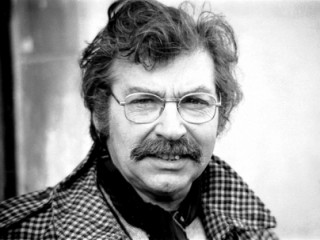
Karel Appel biography
Date of birth : 1921-04-25
Date of death : 2006-05-03
Birthplace : Amsterdam, The Netherlands
Nationality : Dutch
Category : Famous Figures
Last modified : 2011-08-29
Credited as : Artist painter, sculptor, poet
0 votes so far
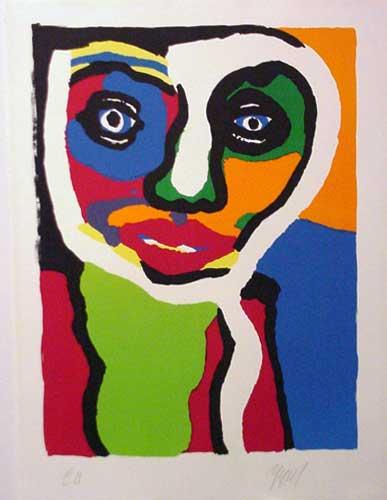
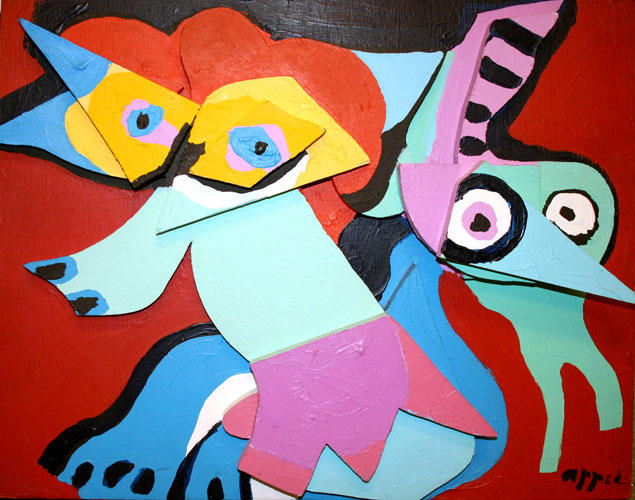
Appel was young, yet his distinctive style was already well-established. Many in the art world were immediately taken by his style. On first observation, Appel's paintings appeared completely abstract, but after viewing them closer, it became clear there were hints of human and/or animal figures included. Some viewers found undertones of spirituality, while others saw terror. While Appel found plenty of admirers, there were also plenty of critics who thought the substance of his work too closely mimicked Pablo Picasso, while his color use too closely mimicked that of Henri Matisse, though Appel blended these traits into his own uniquely personal style. Appel was further influenced by Jean Dubuffet whose work had a primitive, childlike appearance.
Though he was clearly an artist in his own right, Appel was most widely associated with an artist group he helped found in Paris in 1948. Originally, the artists called their new group Reflex, after a magazine members published to air their ideas about art. The group consisted of Dutch, Belgian, and Danish artists and earned the nickname CoBrA, or Cobra an acronym for Copenhagen, Brussels and Amsterdam the hometowns of the founding members. The Cobra movement, which pushed spontaneous expressionism and abstract features, represented a turn from the more formal, geometric European art of the time. Cobra members believed painting opened a porthole into the human psyche.
Though the influential group touched off a Dutch, postwar modern art movement, its members did not stay together long. The artists exhibited together through the early 1950s, alongside such artists as Jackson Pollock, then split up. By 1950, Appel had relocated to Paris, where he continued his work and exhibitions. In 1954, he won the UNESCO Prize (United Nations Educational, Scientific and Cultural Organization) at the Venice Biennale. Appel spent the 1950s touring the United States and Mexico and spent the next several years living between Florence, Italy, and New York City. Besides museums, Appel plastered his work on restaurant walls and was commissioned to paint countless murals in both public and private buildings around the world. In 1949, Appel painted a mural at the Amsterdam City Hall. The piece, which portrayed the smiling, yet grieving faces of the children abandoned after the war, created so much controversy and made city hall workers so uncomfortable that it was covered for nearly a decade. During the 1950s, Appel became enamored with the jazz movement and painted portraits of jazz masters Dizzy Gillespie, Miles Davis, Count Basie, and Sarah Vaughan.
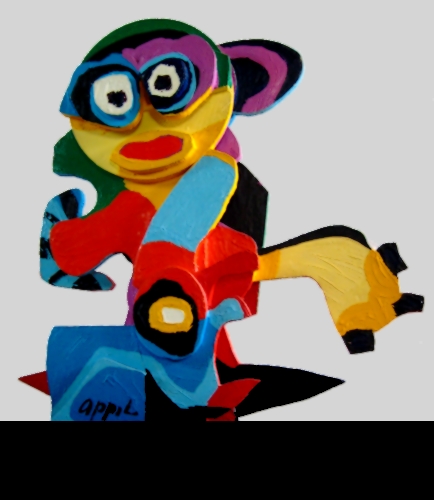
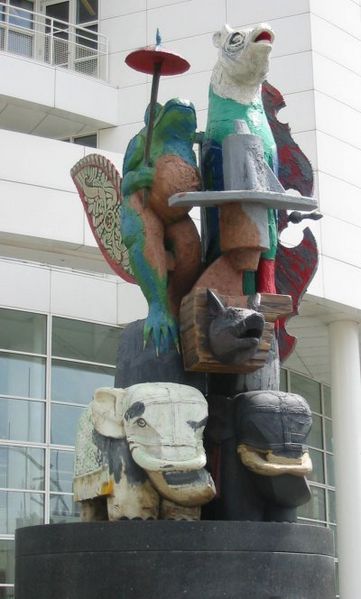
While Appel never tried anything new stylistically in his paintings, he did vary his subject matter. During the early 1960s, he painted a set of female nudes, which many critics likened to the biomorphic shapes painted by Dutch-born artist Willem de Kooning. Later in life, Appel turned to sculpture, incorporating such elements as aluminum, painted wood, and polyester. Many of his sculptures included movable parts.
In one obituary, New York Times writer Margalit Fox described Appel's legacy this way: "Some critics discerned violence or even madness in Mr. Appel's work, with its liberal use of red and its semi-figurative images of grotesque limbs and distorted, grimacing faces. But to other viewers, the unrestrained masses of paint, which Mr. Appel sometimes squeezed onto the canvas straight from the tube, embodied the life force itself."
Appel died May 3, 2006, at his home in Zurich, Switzerland, reportedly of a heart ailment. There were no known survivors. He was 85.