
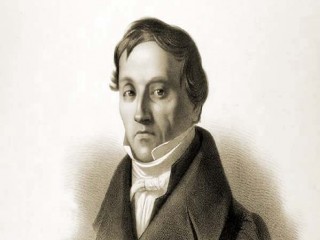
Karl Ernst Von Baer biography
Date of birth : 1792-02-28
Date of death : 1876-11-28
Birthplace : Piep
Nationality : Estonian
Category : Science and Technology
Last modified : 2011-10-10
Credited as : Anatomist, Embryologist, Mammalian ovum
The Estonian anatomist and embryologist Karl Ernst von Baer (1792-1876) was the first to describe the mammalian ovum. He also developed the germ-layer theory, which became the basis for modern embryology.
Karl Ernst von Baer was born in Piep on Feb. 29, 1792. He began his medical studies at the University of Dorpat in Estonia in 1810, and after graduating in 1814 he continued his studies at Vienna. After realizing his limitations as a practitioner, he studied comparative anatomy at the University of WÃrzburg, where he was taught by the influential anatomist Johann Döllinger. On completion of his studies, Baer accepted a position as prosector in anatomy at the University of KÃnigsberg, and in 1819 he was appointed associate professor of zoology there. In 1822 he achieved the rank of professor.
At KÃnigsberg he undertook his famous studies in embryology in collaboration with C. H. Pander. He worked first on the embryology of the chick but later investigated the problem of identifying the structure of the ovum of the dog and found it to be a small yellow spot floating in the follicular fluid. As a result of this work, he published in 1827 the first description of a mammalian egg, Epistola de ovi mammalium et hominis genesi (On the Origin of the Mammalian and Human Ovum). His reputation was further increased by the publication of his most famous work, Entwicklungsgeshichte der Tiere (1828-1837; Developmental History in Animals). In this work he developed the germ-layer theory, in which he held that in vertebrate eggs four "layers" of cells are formed and that each layer always gives rise to certain tissues in the adult organism. (The two middle layers were later regarded as one.) In this same work he outlined his discovery of the notochord in the chick embryo. He described it as a rod of cells which runs the length of the vertebrate embryo and around which the future backbone is laid down.
Baer's work on the embryological development of animals led him to frame four laws. In these laws he was concerned with the question of how closely the development of an embryo of one species resembles that of other species and how closely its various embryonic stages resemble the adult stages of other species. His laws state that the embryo of a given species never resembles the adult of another species and that the embryos of even the most
similar species do not pass through the same states but, rather, become progressively different from each other. These "laws of development," though much misunderstood by other biologists and in some cases used by them to support opposite views, were fruitful in later interpretations of embryology and evolution. Herbert Spencer used Baer's law (later known as the biogenetic law) to support his theory that the world is becoming increasingly differentiated and complicated.
In 1834 Baer left Germany to take up the position of librarian of the Academy of Science at St. Petersburg. In this position he advised the Russian government on a number of scientific matters. In 1837 he led a scientific expedition into Arctic regions, and from 1851 until 1856 he studied Russian fisheries and suggested many improvements. He retired to his native Estonia and died on Nov. 28, 1876, in Dorpat.
There is a very good account of Baer's biological work and influence in Edward Stuart Russell, Form and Function: A Contribution to the History of Animal Morphology (1916). Information is also in Joseph Needham, A History of Embryology (1934; 2d ed. 1959); Arthur William Meyer, The Rise of Embryology (1939); and Jane M. Oppenheimer, Essays in the History of Embryology and Biology (1967).
Baer, Karl Ernst von, Autobiography of Dr. Karl Ernst von Baer, Canton, MA: Science History Publications U.S.A., 1986. □