
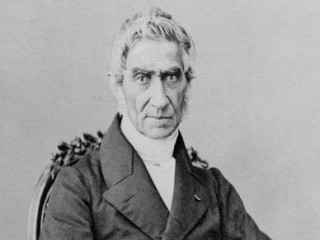
Adolphe Quételet biography
Date of birth : 1796-02-22
Date of death : 1874-02-17
Birthplace : Ghent, Belgium
Nationality : Belgian
Category : Historian personalities
Last modified : 2011-10-13
Credited as : astronomer, founder of modern statistics, social physics
0 votes so far
Adolphe Quételet was born in Ghent on Feb. 22, 1796. When he finished secondary school at the age of 17, he took a job teaching mathematics in a secondary school. A professor of mathematics at the newly established University of Ghent influenced Quételet to study mathematics. In 1819 he received his doctorate in mathematics with a dissertation in which he claimed to have discovered a new curve. The work was heralded as an important contribution to analytic geometry.
That year Quételet was appointed to the chair of elementary mathematics at the Athenaeum, and shortly thereafter he was elected to membership in the Royal Academy of Sciences and Belles-lettres of Brussels. He wrote numerous essays in mathematics and physics, founded and edited a journal, delivered lectures on science in the Brussels Museum, and published introductory works in mathematics and natural science. In 1828 he became the first director of the Royal Observatory, a position held until his death on Feb. 17, 1874, in Brussels.
In Paris gathering technical knowledge for the building of the observatory, Quételet met a number of leading French scientists and mathematicians who were actively engaged in laying the foundations of modern probability theory. Although they were working in the natural sciences and mathematics, in the course of their studies some of them had occasion to analyze empirical social phenomena. What fascinated Quételet was the possibility of using statistics as an instrument to deal with social problems.
Quételet believed that statistical theory and research could be used to determine whether human actions occur with the expected regularity. If so, it would indicate that there are social laws which are as knowable as are the laws which govern the movements of the heavenly bodies. He thought that there were such social laws. He thus developed his famous notion of the "average man."
Quételet's concept of the average man was intended to be a construct of the mind or a model which would enable social "scientists" to express the differences among individuals in terms of their departure from the norm. This theory led to his "theory of oscillation." According to this hypothesis, as social contacts increase and racial groups intermarry, differences between men will decrease in intensity through a process of social and cultural oscillation, resulting in an ever-increasing balance and, eventually, international equilibrium and world peace. Thus, as Quételet saw it, the task of the academic and scientific communities in the immediate future was to develop a new social science, based on empirical observation and the use of statistics. This new science of "social physics" would discover the laws of society upon which human happiness depends. Quételet's subsequent works represent an attempt to formulate this new field of social physics.
To accomplish this goal, it was necessary to refine the techniques used in the collection of statistical data, since Quételet believed that through the analysis of such data empirical regularities or laws could be discovered. He was a moving force behind many of the governmental agencies and professional organizations involved in the gathering of statistical data, and he exerted an international influence on
this area. His application of quantitative methods and mathematical techniques has been judged as anticipatory of the guiding principle of contemporary social science, especially his efforts to change statistics from a mere clerical function into an exact science of observation, measurement, and comparison of results.
Several of Quételet's major works are available in English translation. The best study in English of his significance is Frank H. Hankins, Adolphe Quételet as Statistician (1908), which includes a biographical sketch. See also George Sarton, Sarton on the History of Science, edited by Dorothy Stimson (1962), for the reasons why Sarton considers Quételet rather than Auguste Comte as the "founder of sociology, " and Quételet's work On Man and the Development of His Faculties as "one of the greatest books of the nineteenth century."