
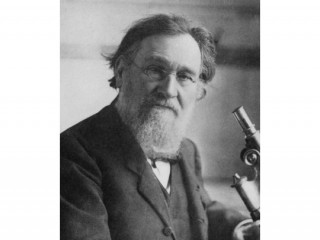
Élie Metchnikoff biography
Date of birth : 1845-05-15
Date of death : 1916-07-16
Birthplace : Ivanovka, Ukraine
Nationality : Ukrainian
Category : Science and Technology
Last modified : 2011-03-17
Credited as : Physiologist, and bacteriologist, phagocytic theory of immunity
The Russian physiologist and bacteriologist Élie Metchnikoff (1845-1916) is best noted for his phagocytic theory of immunity. He also made contributions to comparative pathology, evolutionary embryology, and microbiology. E
On May 15, 1845, Élie Metchnikoff was born in the Ukrainian village of Ivanovka. At the age of 17 he entered Kharkov University; the following year he produced his first scientific work, "Some Facts from the Life of Infusoria" and he completed his studies in the natural sciences by the time he was 19. In 1864 he left for Germany to expand his knowledge of zoology, studying under Rudolf Leuckart, the father of modern parasitology.
Metchnikoff went on to the universities of Gottingen and Munich. He returned to Russia in 1867, received his master's degree in zoology after presenting his thesis, The History of the Embryonal Development of Sepiola, and was appointed dozent at Novorossiisk University in Odessa. In 1868 he successfully defended his doctoral thesis, The History of the Development of Nebalia, at the University of St. Petersburg.
Metchnikoff became professor of zoology and comparative anatomy at Novorossiisk University in 1870. His interest focused on comparative embryology, intracellular digestion of simple organisms, the role of phagocytes in the digestive process, and biological methods of controlling harmful insects. After resigning his position in 1882, he pursued his experiments in his home laboratory, studying pathological microbes. Four years later Metchnikoff, along with Nikolai Fedorovich Gamaleia, organized Russia's first and the world's second bacteriological station. Its function was to prepare vaccines for diseases afflicting man and beast, including rabies, foot-and-mouth disease, anthrax, and cholera. Encountering opposition, ignorance, and animosity from Odessa doctors, St. Petersburg newspapers, and interfering bureaucratic officials, Metchnikoff decided in 1887 to leave Russia forever.
In Paris, Metchnikoff met the ailing Louis Pasteur, and he was given the use of a personal laboratory and title of chief at the Pasteur Institute, where he began the most productive period of his career. The vaguely formulated concepts that Metchnikoff had conceived while investigating intracellular digestion eventually crystallized into his famous phagocytic theory of immunity. In 1883 he had revealed his theory of phagocytosis in "The Curative Forces of the Organism," delivered before the Seventh All-Russian Congress of Naturalists and Physicians in Odessa. The idea that phagocytes, a type of white blood cell, actually destroy living bacteria and other foreign matter and constitute a body's natural defense against infection was not favorably received by many scientists. However, by 1892 the accumulating experimental evidence supported Metchnikoff's theory of immunity. That year he also released his important work Comparative Pathology of Inflammation, and in 1903 his Immunity in Infectious Diseases appeared, soon becoming the classic text on immunology. For his many works on the processes of immunity he shared the Nobel Prize in 1908.
In 1903 Metchnikoff was appointed deputy director of the Pasteur Institute. About this time he began investigating old age. His ideas on the aging process appear in The Nature of Man (1903), Studies in Optimism (1907), and Forty Years' Search for a Rational Outlook (1913). He proposed the controversial theory of orthobiosis, which stressed "hygienic rules" for the prolongation of life. Despite frequent opposition to his theories, Metchnikoff became a renowned figure in the world of science and received many honors, awards, and titles. He died on July 16, 1916.