Pablo Casals biography
Date of birth : 1876-12-29
Date of death : 1973-10-23
Birthplace : Vendrell, Catalonia, Spain
Nationality : Spanish
Category : Famous Figures
Last modified : 2010-08-31
Credited as : Composer, cellist and conductor, Bach's music
1 votes so far
Pablo's Early life
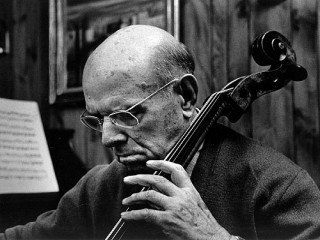
Pablo Casals was born on December 29, 1876, in Vendrell, in the Catalonian region of Spain. He was the second of eleven children of Carlos Casals and Pilar Defillo de Casals. Casals's father, the local church organist, would play the piano while the infant Casals rested his head against it and sang along. By the age of four Casals was playing the piano, and at five he joined the church choir. At six he was composing songs with his father, and by the age of nine he could play the violin and organ. From the age of ten Casals began each day with a walk, taking inspiration from nature. He would then play two Johann Sebastian Bach (1685–1750) pieces on the piano when he returned home.
Masters the cello
Casals became interested in the cello after seeing the instrument in a music recital at age eleven; soon, his father built him one. His parents argued about his future; his father wanted him to study carpentry, but his mother would not hear of it and enrolled him in the Municipal School of Music in Barcelona, Spain. Casals clashed with his strict instructors, preferring to play the cello in his own, more expressive, manner. His progress was extraordinary, and Casals's new way of playing made the cello a more popular instrument.
Among those impressed by Casals was the Spanish composer Isaac Albéniz (1860–1909). After hearing Casals play, Albéniz gave him a letter of introduction to Count Guillermo de Morphy, secretary to the Queen Regent of Spain, Maria Cristine. In 1894 Casals traveled to Madrid, Spain, and gave concerts for the queen and her court. Over the next few years his reputation spread as he played with various orchestras in Madrid. With his formal debut as a concert soloist in Paris, France, in 1899, Casals's career was assured.
New respect for Bach's music
Sometime in 1890, while Casals and his father were in a Barcelona bookstore, he found a volume of Bach's six suites (arrangements of music) for solo cello. Previously the suites were considered merely musical exercises, but Casals saw in them something deeper. He studied and practiced the suites every day for a dozen years before performing them publicly; he continued to play at least one suite every day for the rest of his life.
Casals's performance of the suites shocked listeners by correcting the previously held belief that Bach's solo music for strings had no warmth or artistic value. Casals's love of Bach's music carried over into the rest of his life. As he told José Maria Corredor in Conversations With Casals, "I am everyday more convinced that the main-spring of any human enterprise must be moral strength and generosity." Casals came to understand the suffering of the poor as he walked the streets of Barcelona. He vowed to use his music to help his fellow people.
Silenced cello in protest
Casals often wrote letters and organized concerts on behalf of the oppressed, and he refused to perform in countries, such as the Soviet Union, Germany, and Italy, whose governments mistreated their citizens. After the Spanish Civil War (1936–39), when General Francisco Franco took power, Casals announced he would never return to Spain while Franco was in charge. He settled in Prades, France, and gave occasional concerts until 1946, when, to take a stand against tyrants such as Franco, Casals vowed never to perform again.
However, encouraged by friends, Casals resumed playing in 1950, participating in the Prades Festival organized to honor Bach. At the end of the festival and every concert he gave after that, Casals played "Song of the Birds," a Catalonian folk song, to protest the continued oppression in Spain. In 1956 he settled in Puerto Rico and started the Casals Festival, which led to the creation of a symphony orchestra and a music school on the island. Casals never returned to Spain.
Casals also continued to refuse to perform in countries that officially recognized the Franco government. Until his death in 1973, Casals made only one exception—in 1961 he performed at the White House for U.S. President John F. Kennedy (1917–1963), a man he greatly admired. In 1971, at the age of ninety-five, he performed his "Hymn of the United Nations" before the United Nations General Assembly. Casals sought to inspire harmony among people, with both his cello and his silence.