
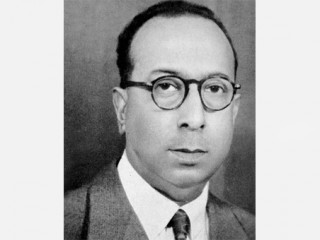
S. K. Mitra biography
Date of birth : 1890-10-24
Date of death : 1963-08-13
Birthplace : Calcutta, India
Nationality : Indian
Category : Science and Technology
Last modified : 2010-06-02
Credited as : Scientist, ,
0 votes so far
While the crowd shouted and applauded the feat, a nine-year-old boy was puzzled. He tugged at the shirt of his elder brother and asked, “How did the balloon rise?” His brother could not give him a satisfactory answer. The boy began looking for it in science books and magazines. In due course, he came across the writings of Dr. J.C. Bose. This was how the boy came to be interested in science and grew up to become a top scientist. His name was Sisir Kumar Mitra.
S. K. Mitra was born on October 24, 1890, in Calcutta and was an earnest student from childhood. During collage days he had the privilege of watching closely J.C. Bose and P.C. Ray doing research. In fact, Bose’s pioneering equipment for generating radio waves influenced him to take up research in radio science.
Later, when he realized the important of this newborn science in communication, he introduced it in the country. Thanks to his untiring efforts, the subject gained importance in Indian universities. The radio industry was started in the country. The Haringhata Ionosphere Field Station was installed and the Institute of Radio Physics and Electronics founded in Calcutta.
In the scientific world Mitra is renowned for his contributions to the study of the ionosphere. The ionosphere is a layer containing electrically charged particles called “ions” in the upper atmosphere which reflects it back to the earth and our radio or television set receives it. The study of the ionosphere is, therefore, vital for radio communication.
The ionosphere is composed of several layers designated as D, E, F and so on depending upon height and property. On the basis of his investigations, Mitra claimed that ultra-violet radiations emitted by the sun produced the E layer of the ionosphere. It was a wonderful achievement as the presence of this layer had baffled scientists the world over.
Besides numerous other contributions, Mitra also found out why the night sky appears dusty black and not jet black as it should. He attributed this to the presence of ions in the F layer, which emit some light, the process being called “night sky luminescence”.
In 1958, Mitra was elected Fellow of the Royal Society. He also received several awards and medals. In 1947 he wrote The Upper Atmosphere, the first treatise on the subject which received worldwide appreciation.
He died at the age of 73 on August 13, 1963.