
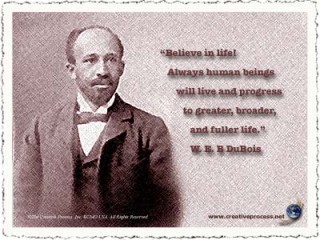
W. E. B. Du Bois biography
Date of birth : 1868-02-23
Date of death : 1963-08-27
Birthplace : Great Barrington, Massachusetts, United States
Nationality : Ghanian
Category : Famous Figures
Last modified : 2010-07-13
Credited as : Writer and editor, The Crisis and the NAACP,
11 votes so far
Early career
Du Bois graduated from Fisk University, a black institution at Nashville, Tennessee, in 1888. He received a Ph.D. from Harvard University in 1895. His doctoral dissertation, The Suppression of the African Slave-Trade to the United States of America, 1638–1870, was published in 1896. Although Du Bois took an advanced degree in history, he was broadly trained in the social sciences; and, at a time when sociologists were theorizing about race relations, he was conducting empirical inquiries into the condition of blacks. For more than a decade he devoted himself to sociological investigations of blacks in America, producing 16 research monographs published between 1897 and 1914 at Atlanta (Georgia) University, where he was a professor, as well as The Philadelphia Negro; A Social Study (1899), the first case study of a black community in the United States.
Although Du Bois had originally believed that social science could provide the knowledge to solve the race problem, he gradually came to the conclusion that in a climate of virulent racism, expressed in such evils as lynching, peonage, disfranchisement, Jim Crow segregation laws, and race riots, social change could be accomplished only through agitation and protest. In this view, he clashed with the most influential black leader of the period, Booker T. Washington, who, preaching a philosophy of accommodation, urged blacks to accept discrimination for the time being and elevate themselves through hard work and economic gain, thus winning the respect of the whites. In 1903, in his famous book The Souls of Black Folk, Du Bois charged that Washington's strategy, rather than freeing the black man from oppression, would serve only to perpetuate it. This attack crystallized the opposition to Booker T. Washington among many black intellectuals, polarizing the leaders of the black community into two wings—the “conservative” supporters of Washington and his “radical” critics.
Two years later, in 1905, Du Bois took the lead in founding the Niagara Movement, which was dedicated chiefly to attacking the platform of Booker T. Washington. The small organization, which met annually until 1909, was seriously weakened by internal squabbles and Washington's opposition. But it was significant as an ideological forerunner and direct inspiration for the interracial NAACP, founded in 1909. Du Bois played a prominent part in the creation of the NAACP and became the association's director of research and editor of its magazine, The Crisis. In this role he wielded an unequaled influence among middle-class blacks and progressive whites as the propagandist for the black protest from 1910 until 1934.
Black nationalism and socialism
Du Bois's black nationalism took several forms—the most influential being his pioneering advocacy of Pan-Africanism, the belief that all people of African descent had common interests and should work together in the struggle for their freedom. Du Bois was a leader of the first Pan-African Conference in London in 1900 and the architect of four Pan-African Congresses held between 1919 and 1927. Second, he articulated a cultural nationalism. As the editor of The Crisis, he encouraged the development of black literature and art and urged his readers to see “Beauty in Black.” Third, Du Bois's black nationalism is seen in his belief that blacks should develop a separate “group economy” of producers' and consumers' cooperatives as a weapon for fighting economic discrimination and black poverty. This doctrine became especially important during the economic catastrophe of the 1930s and precipitated an ideological struggle within the NAACP.
He resigned from the editorship of The Crisis and the NAACP in 1934, yielding his influence as a race leader and charging that the organization was dedicated to the interests of the black bourgeoisie and ignored the problems of the masses. Du Bois's interest in cooperatives was a part of his nationalism that developed out of his Marxist leanings. At the turn of the century, he had been an advocate of black capitalism and black support of black business, but by about 1905 he had been drawn toward socialist doctrines. Although he joined the Socialist Party only briefly in 1912, he remained sympathetic with Marxist ideas throughout the rest of his life.
Upon leaving the NAACP, he returned to Atlanta University, where he devoted the next 10 years to teaching and scholarship. In 1940 he founded the magazine Phylon, Atlanta University's “Review of Race and Culture.” In 1945 he published the “Preparatory Volume” of a projected encyclopaedia of the black, for which he had been appointed editor in chief. He also produced two major books during this period. Black Reconstruction: An Essay Toward a History of the Part Which Black Folk Played in the Attempt to Reconstruct Democracy in America, 1860–1880 (1935) was an important Marxist interpretation of the Reconstruction era (the period following the American Civil War during which the seceded Southern states were reorganized according to the wishes of Congress), and, more significantly, it provided the first synthesis of existing knowledge of the role of blacks in that critical period of American history. In 1940 appeared Dusk of Dawn, subtitled An Essay Toward an Autobiography of a Race Concept. In this brilliant book, Du Bois explained his role in both the African and the African American struggles for freedom, viewing his career as an ideological case study illuminating the complexity of the black-white conflict.
Following this fruitful decade at Atlanta University, he returned once more to a research position at the NAACP (1944–48). This brief connection ended in a second bitter quarrel, and thereafter Du Bois moved steadily leftward politically. Identified with pro-Russian causes, he was indicted in 1951 as an unregistered agent for a foreign power. Although a federal judge directed his acquittal, Du Bois had become completely disillusioned with the United States. In 1961 he joined the Communist Party and, moving to Ghana, renounced his American citizenship more than a year later. The Autobiography of W.E.B. Du Bois was published in 1968.